Over the past 15 years or so, I have engaged in a number of debates with other scholars, as I believe strongly that this kind of interaction is an excellent way to question and improve our culture's mainstream views. In this post, I'd like to highlight the more adversarial of these debates. By 'adversarial' I don't mean unfriendly; some may be, but many aren't. I mean simply that these 'adversarial' engagements entailed mutual critiques of different, perhaps even contradictory views. This helps us make the potential shortcomings of the respective views more explicit, which is surely a progressive thing.
The first is a debate with well-known materialist and skeptic Prof. Peter Atkins and Prof. Nancy Cartwright. I was surprised with how open to my ideas Prof. Atkins seemed to be already very early on in the debate.
The next debate is with Prof. Susan Blackmore, a well-known skeptic, and Prof. Tim Crane. The debate was moderated by Hilary Lawson. Here again I was surprised with Susan's relative openness to my views.
Now a debate with well-known atheist philosopher of religion, Prof. Graham Oppy, considered by William Lane Craig "the most formidable atheist philosopher writing today." We seem to be less distant from, and antagonist of, each other's position than I thought before this dialogue.
Next up is my debate with anaesthesiologist and well-known skeptic, Dr. Gerald Woerlee. After this debate I realized that many of Dr. Woerlee's views are actually in alignment with analytic idealism. The debate was done in two parts, and covers a lot of ground.
Now a conversation with my friends, neuroscientist Dr. Christof Koch and philosopher Rupert Spira. I list this as an 'adversarial' debate because, at the time, Christof and I thought we had sharply divergent views (which wasn't quite true already then). In a more recent discussion, also linked below, we show how much closer to each other's views we actually are.
Next is a debate with Prof. Carlo Roveli, who I am always delighted to dialogue with.
The next one is again a debate between very contrasting views, as Prof. David Papineau is a well-known physical realist, the antithesis of analytic idealism. Yet, I was again surprised with how seemingly open to other possibilities he seemed to be, provided that these possibilities are based on reason and evidence. At some point, if I recall correctly, he even granted that I was not crazy, which is high praise (I say this sincerely, only very slightly tongue-in-cheek). The moderator didn't allow us to converse as much as we would have liked, but perhaps we will do it again some time.
Now a debate with Prof. Susan Schneider and my friend Prof. Donald Hoffman. I list this as adversarial because Susan's views on the hypothesis of artificial sentience contrast very sharply with my own, which led to a fairly robust exchange between us at a certain moment.
And here's another debate with skeptic, Prof. Susan Blackmore:
Harvard Prof. Avi Loeb and I are both open to the possibility of alien life, but we differ in the ever so important details, so I list this as a friendly but adversarial debate.
Prof. Brian Keating and I hold contrasting views on a number of issues. Yet, our dialogue betrayed more agreement than disagreement, so I hesitated about whether to list this one as an 'adversarial' debate. But I wouldn't be portraying Brian's views properly if I suggested that we are on the same boat, so here you go.
Now a debate with arch-materialist and skeptic Prof. Patricia Churchland and, again, Prof. Carlo Roveli, this time moderated by Closer-to-Truth host, Robert Lawrence Kuhn. The biggest surprise here was Churchland's seemingly complete unawareness of over 10 years of psychedelic research and its most significant results. For a self-identified "neurophilosopher," this was rather embarrassing.
Finally, here's a very adversarial debate I had with YouTuber physicist Sabine Hossenfelder. I initially didn't intend to list this one here because I believe my interlocutor was deliberately, well, very misleading in the exchange and didn't abide by a bare-minimum level of debate ethics. But for the sake of completeness, here it is. To understand why I feel uncomfortable with what happened in this exchange, check out these posts:
A couple of weeks ago, Dr. Sam Parnia released a new mini-documentary about Near Death Experiences (NDEs), which he now coined a new term for: REDs, for 'Recalled Experiences of Death.' His argument is that, physiologically, these people weren't merely near death, but actually died and were resuscitated thanks to modern medical technology. Indeed, defining death as a state one can never return from is operationally contingent; it is arbitrary and ignores the physiology—the science—of the process. So I am comfortable with the term RED.
But I diverge. The point of this essay is a common feature of REDs and 'Out of Body Experiences' (OBEs) that have always stricken me as exceedingly odd: the claim by experiencers that they could perceive the colloquially physical world around them—from a mildly elevated, bird's-eye perspective—during the period of, e.g., cardiac arrest, as if they still had working eyes and ears. This seems to violate logic, as evolution required hundreds of millions of years of painstaking adaption to come up with retinas and eardrums. And that these are needed to perceive the world is unquestionable: right now, if you close your eyes and ears, you will see and hear nearly nothing. So how can a patient under cardiac arrest, lying on a hospital bed with eyes closed, see and hear what is going on in the corridors outside their room? If one can see and hear perfectly well without working eyes and ears, why do we need them at all? Why can't I close my eyes right now and see what's happening around the corner of my street?
Nonetheless, I am not one of those people who find it easy to disregard (anecdotal) evidence just because it doesn't fit with their understanding of the world. As a friend reminded me of just a couple of days ago, alluding to a particular scene from the Netflix series Chernobyl, theory must fit the facts, not the other way around. And there are just too many mutually-consistent reports to dismiss. My commitment to truth is such that I just can't pretend otherwise, which puts me at an impasse, for I am equally unable to think of nature as something so capricious as to change the rules of the game on a whim. I just can't accept that eyes and ears are utterly unnecessary to perceive this world during a RED or OBE, but absolutely necessary during ordinary waking states. Moreover, nature just isn't so redundant as to struggle for hundreds of millions of years to evolve retinas and eardrums we can allegedly do perfectly well without.
The present essay is the result of my struggle to make sense of this conundrum. At this stage, however, what follows is still very highly speculative and should be taken with a whole bag of salt. I am not at all committed to the conjectures I discuss below, but simply play with them as an intellectual exercise. In the future, I may further expand on these thoughts in a more rigorous manner, if my argument can be more substantiated. Alternatively, I may abandon the idea altogether. Either way, right now what follows is just a very loose exercise of theoretical imagination, nothing more.
Finally, notice also that the Phantom World Hypothesis is supposed to cover only the parts of a RED or OBE that seem to relate directly to the ordinary, so-called physical world; not the parts about transcendence and other realities.
Assumptions
I am not a RED/OBE researcher or scholar. My interest in these states is professional but ancillary. Therefore, I must start with some basic assumptions, knowing full well that these may ultimately prove to be wrong or misleading. My assumptions are these: (a) experiencers of REDs/OBEs are being sincere and reasonably accurate when they report the ability to perceive the ordinary, colloquially physical world during the period in which they do not have functioning sensory organs; (b) Nature indeed isn't redundant or whimsical, so despite their sincere reports, experiencers in fact aren't truly perceiving the colloquially physical world around them.
Background
I will base my hypothesis on the tenets of my own Analytic Idealism. According to it, all nature consists of experiential—i.e., mental—states. Some of these states are within our individual minds, such as our own perceptions, thoughts and emotions. We identify with these internal states or at least feel that we own them. Other mental states in nature are external to our individual minds and, therefore, constitute the external environment we inhabit. I shall say that these external mental states belong to a 'mind-at-large' beyond our individual minds.
That there can be mental states out there, outside your individual mind, is nothing new: my thoughts are mental, and yet external to your mind. Analytic Idealism simply leverages this trivial fact to argue that the entire world beyond the boundaries of our own minds is constituted of external mental states as well, not just the inner lives of other people.
When external mental states in mind-at-large impinge on our individual minds, they modulate our internal mental states. This is what we call perception: what we see, hear, taste, smell, and touch are our innerrepresentations of external states. As such, under Analytic Idealism there is indeed an external world beyond us; a world that does not depend on us to exist or do whatever it is that it does. When we interact with this world—such that the world impinges on us—its states are represented by our individual minds as the colloquially physical world around us. As such, what we perceive is merely an image, an appearance of states in mind-at-large.
Still under Analytic Idealism, what separates our internal mental states from the external mental states of mind-at-large is a dissociative boundary. Just like the multiple, disjoint personalities—called 'alters'—of a patient of Dissociative Identity Disorder (previously known as 'Multiple Personality Disorder'), each living being is a dissociative alter of the field of mentation that constitutes nature. A biological organism is what one such an alter looks like when represented on the screen of perception. Biology, life, is the perceptual appearance of a dissociative alter in the universal mind we call nature.
As such, death—the end of life—is, in fact, merely the end of the dissociation, of the alter, not the end of consciousness. The dying process is that by which the previously private mental states of the alter—one's personal memories, insights, etc., originally insulated from their cognitive surroundings by a dissociative boundary—become progressively re-associated with the mental states of mind-at-large. It stands to reason, thus, that this should be experienced as an expansion of consciousness, not its end, which is precisely what experiencers of REDs/OBEs report.
The Phantom World Hypothesis
Among the previously private mental states of an alter undergoing re-association—i.e., a person dying, being re-integrated into his or her cognitive surroundings—are episodic memories. These contain a lifetime of perceptions: a cognitive map of one's home, neighbourhood, city, country, places visited or seen on TV shows and YouTube videos, and so on. We don't just perceive the world, we also remember these perceptions. As these perceptual memories accumulate over time, they form an increasingly broad, high-resolution, internal map of our environment, constituted of the qualities of perception: the colours, shapes, contours, and geometrical relationships that define what we colloquially call the physical world. Even when you are lying in bed at night, with your eyes closed, you can access these perceptual memories to visualise your room, your street, the route to work that you will be taking in the morning, etc. As such, a copy—more or less precise, more or less accurate, more or less comprehensive—of the world as perceived exists in us at all times.
When we die, this copy of the world as perceived and remembered becomes re-integrated with the external mental states of mind-at-large. And since people are dying every minute, mind-at-large becomes increasingly enriched with individual perceptual maps, which are representations of its own states. These perceptual maps—each corresponding to the perceptual memories of a re-integrated alter—become cognitively associated with one another, like different pieces of a giant jigsaw puzzle coming together. It is reasonable to infer this because we know that this is how mind works: through spontaneous cognitive associations based on similarities and correspondences. Mind-at-large cannot help but spontaneously put the pieces of the puzzle together.
Nature's mind is thus constantly assembling a cognitive map of itself—a jigsaw puzzle representing its own states, whose pieces are constituted of qualities of perception—based on the episodic memories it inherits from re-integrated alters. Where there are gaps, extrapolations spontaneously arise, just as we extrapolate our own perceptions to infer that, say, a wall partly obscured by a tree in fact continues behind the tree; or that a road continues beyond the visible horizon; etc. These extrapolations reflect well-known and intrinsic properties of mentation: you spontaneously extrapolate a square from the figure below, even though there is no square in it at all; you do it because this is what mind naturally does. Technically called interpolations, theextrapolations complete the jigsaw puzzle where pieces are still missing. The result may be an inaccurate but rather complete cognitive map, a Phantom World constituted of perceptual qualities originally generated by living people and other organisms.
I call the resulting map a Phantom World because mind-at-large isn't actually perceiving the world; it isn't actually representing its own states on a screen of its own perception. Instead, it is merely inheriting the perceptual states of myriad former alters and spontaneously assembling them together through cognitive similarity and correspondence. The resulting pseudo-perceptual world is thus an approximation containing inaccuracies and imprecisions (the interpolations). Nonetheless, it should still feel as though it were a (colloquially physical) world perceived, since it is made of qualities of perception like the colours and sounds you and I see and hear.
During a RED or OBE, I contend that the dissociative boundary that defines the individual mind of a person becomes weakened, porous, permeable, allowing for partial but direct access to external states in mind-at-large, without the intermediation of a screen of perception. And since these external states contain the Phantom World, the experiencer gains temporary access to that pseudo-perceived world.
I suggest, therefore, that the experiencer is not actually perceiving the real world, but the Phantom World instead. For this, the experiencer indeed does not require working eyes or ears, for he or she is accessing the compound result of myriad episodic memories—the assembled jigsaw puzzle—of people who did have working eyes and ears. Analogously, when you are lying on your bed at night, with your eyes closed, visualising your route to work the next morning, you too can visualise it by recalling episodic memories and without using your eyes.
Perspectival transposition
A number of possible criticisms of this hypothesis must be popping in your mind right now. I will try to anticipate and address them in this and the next sections.
The first issue is the perspective experiencers report: a bird's-eye view of things, as if they were floating above other people, the furniture, the cars on the streets, etc. This perspective does not correspond to the episodic memories of any human being, dead or alive, since we don't ordinarily float around like air balloons. How can this be accounted for under the Phantom World Hypothesis?
Even in ordinary waking states, our minds routinely adjust our perceptual experience so to conform to an expected context or perspective. In other words, we don't just perceive the world as it is, we manipulate our perceptual states so they fit with the context we cognitively expect. This is so even when you know what is going on. In the picture below, for instance, the squares marked A and B have exactly the same colour. Yet, because the context forces you to expect them to have opposite colours, that's what you see. And you will continue to see it even after you convince yourself that the squares do indeed have the same colour.
The drawing below contains a variety of perspectival illusions. Even after we realise that what we think we are seeing is impossible, we continue to see it nonetheless. This is an intrinsic property of mind: it tries to fit what it perceives to its expectations and models of what is going on.
There are countless other compelling examples of our minds imposing a perspective onto the contents of perception that is not there at all. The video below is just one more example, where we impose very specific movement where there is none. And even knowing this, and being convinced of it, does not reduce—let alone eliminate—the seeming perception.
Staring at this optical illusion where the boxes are not moving - my brain can't comprehend! pic.twitter.com/9TcgbQfxVL
My contention is thus the following: during a RED/OBE, the experiencer expects to perceive the world from his or her own unique and contingent point of view, not the objective perspective of other people, dead or alive. To reconcile his or her access to the Phantom World with this expectation, the experiencer transposes his or her experiential vantage point accordingly, thereby generating the bird's-eye view. This is possible because the Phantom World is already a cognitive model—an interpolation—anyway, so any perspective can be 'computed' from it through a form of grounded, calibrated imagination.
Ongoing experiences
Another issue with the Phantom World Hypothesis is that experiencers often report, veridically, what is going on in the world during the RED/OBE: what people are saying, doing, etc., while the experiencer is in, e.g., cardiac arrest. This means that their pseudo-perceptions cannot be grounded only in the episodic memories of the deceased, but also in the ongoing experiences of living people, as they unfold.
Under Analytic Idealism, the mental inner lives of two different people are ordinarily separated from one another by two dissociative boundaries, each defining the limits of each person's individual mind. During the RED/OBE, however, we've hypothesised that the dissociative boundary of the experiencer becomes weaker, porous, permeable. As such, it is reasonable to conjecture that access to another person's on-going experiences becomes easier than under ordinary circumstances. This is especially so if those other people are emotionally connected with the experiencer, which could spontaneously shift their own state of consciousness in a manner that weakens their own dissociative boundary as well.
If this direct mind-to-mind access does take place, it is in principle reasonable to conjecture that the experiencer will import it into the Phantom World—to keep everything consistent and unified—and again spontaneously apply a perspective transposition, as discussed in the previous section, so to portray such access as if it were taking place from an external vantage point. After all, the experiencer doesn't expect himself/herself to be another person. Instead, things will be experienced as if he/she were seeing or hearing another person. The experiencer will then report having seeing or heard other people say or do this or that, while, in fact, the experiencer has directly accessed their inner mental states.
Implications and validation
To check whether the Phantom World Hypothesis is consistent with the (anecdotal) RED/OBE data, we must derive its implications and check them against what experiencers report. So let us do this, one implication at a time.
If some of what is reported corresponds to direct access to the inner mentation of living people—subsequently transposed to an external perspective—then experiencers should, at least occasionally, report accessing endogenous mental states of others as well. In other words, in addition to knowing what people said or did, experiencers should, at least occasionally, claim that they knew what people were thinking or feeling. And indeed, this is precisely what is often reported. In the recent mini-documentary by Dr. Sam Parnia, linked above, an experiencer claimed to have become aware of what his doctor was thinking—a claim confirmed by the doctor—while the experiencer himself was in cardiac arrest. If the experiencer can access someone's thoughts, than she or he surely can access what one is seeing, hearing, or otherwise perceiving. This corroborates the hypothesis that experiencers aren't actually perceiving the real world without functioning eyes or ears, but pseudo-perceiving the world by proxy, through the inner mental states of both the deceased and the living.
Another implication of the Phantom World Hypothesis is that, since the Phantom World is a cognitive construct, a model containing interpolations and extrapolations, at least occasionally experiencers should report things that don't actually match with the real world. These inaccuracies are probably filtered out in the popular literature, since they can easily be (mis)interpreted as refuting the validity of the RED/OBE. Yet, under the Phantom World Hypothesis, occasional inaccuracies and oddities are precisely what one would expect. These inaccuracies—provided that they are localised within a broader context that is itself veridical—in fact corroborate the validity of the RED/OBE.
Finally, the most important implication of the Phantom World Hypothesis is this: the experiencer should not be able to know any fact that has never been experienced by any organism still alive or already dead. Because the hypothesis entails that experiencers only pseudo-perceive the world—that is, perceive by proxy, through the inner mental states of others—whatever no one has ever perceived or otherwise known cannot be accessed by the experiencer. As such, when Dr. Sam Parnia devised his famous experiment to test the veracity of REDs—wherein he placed electronic displays on top of tall cupboards, facing up and displaying random numbers automatically chosen by a computer, to see if the 'free-floating soul' would be able to read the numbers—he ensured that no experiencer would succeed. After all, the experiment was designed to be double-blind: the experimenters themselves didn't know what numbers were displayed. Therefore, no one, dead or alive, knew what the numbers were. It was impossible for the experiencers to access such information, since their access is always by proxy and not direct. The experiencers don't have eyes to perceive the displays; they can only see what others see or have seen. Again, this implication of the Phantom World Hypothesis seems to match with the data, as Parnia's experiment is known to have 'failed.'
Conclusions
The Phantom World Hypothesis should not be taken as a rigorous scholarly theory, for it is no such thing; at least at the present time. As it stands, the hypothesis is merely educated speculation and conjecture, with very little theoretical underpinning or empirical basis. But the little it does have is, well, a little intriguing.
I am not an experimentalist in the field of REDs/OBEs. I cannot, therefore, take it on myself to design and carry out experiments to validate or falsify my own hypothesis. But those who are in the position to do so could perhaps allow themselves to be informally informed by the Phantom World Hypothesis in their experimental designs. Doing so would prevent the understandable but possibly equivocated jump to concluding that Parnia's experiment debunks the veridical aspect of REDs, for its very double-blind design could have precluded any veridical report.
New experiments are needed that are informed by the Phantom World Hypothesis.
I originally intended to publish the essay below in an (online) magazine, not my own blog. I still have this intention, but opted to publish the complete draft here first for several reasons: (a) most magazines will place the essay behind a paywall (I already tried to negotiate this out, but it is not negotiable); (b) most magazines will require me to significantly shorten the essay (even Aeon Magazine, which publishes long-form essays, limits them to 5,000 words, while the text below has over 6,800 words); (c) most magazines will force me to edit at least some parts of my argument in a manner that is not preferable to me; and (d) the editorial process entailed in a magazine publication of an essay as elaborate as this can take many months. For these reasons, I decided to publish the entire draft here first, prior to any editorial changes, in the spirit of a pre-print in the ArXiv. It remains possible that future, shortened, edited versions of the material below will appear in other magazines.
You may have noticed that, since Essentia Foundation started in earnest in the summer of 2020, my philosophical output essentially ground to a halt. Indeed, my latest published book to-date, Science Ideated, was finished in April of 2020, even though it only came out in 2021. The reason for this is that Essentia Foundation took all my time in its first years. Starting a new organisation and team from scratch isn't trivial. Moreover, running Essentia Foundation resonated so profoundly with the path of meaning in my life that it basically became an 'obsession'—something I don't consider bad at all; in fact, I love it, despite the overtones of the word 'obsession.' In view of this, my own personal production had to take a backseat over the past three or four years.
Yet, ideas have been autonomously arising and simmering in the back of my mind, growing and congealing beyond the scrutiny of my ego, in their own space and their own time, with little to no effect in my outward daily life. And now they seem to be mature enough to be birthed into the world with little demand on my time. This is what I'd like to share with you now, as 2024 begins.
My intent with what follows is not so much to commit to any kind of new year's 'resolution,' but instead to bring you more squarely onboard our journey together through idea-space; for 2024 marks the beginning of a period of a few years that will probably be remembered as one of the most defining in the whole of human history; a unique time to be alive. I will also share, towards the end of this post, my predictions for this seminal period that has just begun.
The new book
The first news is that my new book, Analytic Idealism in a Nutshell, will be officially published in October of 2024. Here is an overview of the book's goals, quoted from Chapter 1, so to help you place its usefulness, value-add, and role in the broader context of my work:
Analytic Idealism—the subject of this book—represents a correction of our known metaphysical mistakes; a step forward. As I shall soon argue, it offers the most plausible and parsimonious hypothesis we have today about the nature of reality. Herein lies the value of what you are about to read.
I have written ten earlier books and a PhD thesis on the subject, not to mention a number of technical papers in academic journals, blog posts, and popular science & philosophy essays in major publications. So, what is new in this particular volume? As the title of this book indicates, here I attempt to summarize, in an informal but direct manner, the key salient points of Analytic Idealism and the argument that substantiates it. Ideas from several of my previous writings are revisited here, but often in a new form, from a different slant. And they are brought together so to give you the briefest and most compelling overview of Analytic Idealism I could muster.
In addition, as I’ve found myself having to explain and defend Analytic Idealism in countless interviews, Q&A sessions, panels, debates, courses, and other public events over the years, I’ve had to distill a more optimal way to bring forth the core ideas. I’ve learned over time what the main difficulties are that different people have with Analytic Idealism, and refined ways to explain it so to meet people where they are, honoring their intuitions and tackling their hidden assumptions more explicitly. All these learnings and refinements are built into the present volume.
Stylistically, my previous ten books were meticulously documented. The same goes for my second PhD thesis and my many technical papers in peer-reviewed academic journals. I thus believe that I have earned the right to discuss Analytic Idealism now in a less formal, less documented, but more fluent and easy-to-read manner, capturing the most salient points in more intuitive, colloquial language. This is what I try to achieve in this book. Unlike previous writings, here I shall thus deliberately avoid formal literature citations, bibliography, and notes. Whenever a literature reference seems particularly productive or unavoidable, I shall mention it in the running text, just as I already did above.
This book is meant to be as close as possible to a verbal discussion of Analytic Idealism, as if I were explaining it to you in person. The tone adopted deliberately reveals more aspects of my own humanity and emotional state to the reader, which can be contrasted to the drier and more objective character of my technical writings. For those readers who prefer or require a technical and more rigorously documented argument, I recommend my earlier output, much of which—such as the academic papers and thesis—is freely available online.
An IIT-based model of dissociation
But as much as Analytic Idealism in a Nutshell brings a form of closure to my formulation of idealism, it also opens a door to a new theoretical development. Although the empirical appeal to dissociation is sufficient to substantiate Analytic Idealism, one would like to have a more formal, conceptual, explicit account of the process of dissociation—What is it, precisely? How does it work? What are the causal mechanisms and dynamics involved? etc.—something that isn't available in the literature today. This new theoretical effort will be the main focus of my personal work in the course of 2024, and very likely beyond.
Since 2017, but mostly in 2023, an idea has been taking root in my mind about how Integrated Information Theory (IIT) can be used as the basis of a theoretical model of dissociation. IIT's 'exclusion principle,' in particular, seems to be the missing theoretical insight that enables such a model. Therefore, instead of taking most of my spare time to talk about Analytic Idealism in podcast interviews, in 2024 I plan to give less interviews, go to less events, generally talk less and do more. I feel a movement of the impersonal inside me that pushes me to return to theoretical meditation, to developing new ideas, as opposed to communicating older ones.
It will be a challenge to carve out more time to retire in quiet thinking—a return to the mode of being that characterised my philosophical life before I wrote my first book—because my email box has never been so overwhelmed with requests for interviews, participation in events, debates, travel, etc. But I will do my best, for my Daimon wants precisely that: a return to the contemplative state of mind that enabled my entire work thus far, and is necessary for its progression. If you thus notice less public material featuring me coming out this year, please know that it is for a good cause.
The Daimon
Speaking of the Daimon, for the past three or four years I've been thinking of writing a book about my life with the Daimon: the irresistible movements of the impersonal within me, which set the direction of my life and couch it in meaning. As you're bound to have heard my saying before, my life is not about me: instead, it's about what nature—embodied in the metaphorical figure of the Daimon—wants to do through me. This relationship with the impersonal has marked my entire life, since long before I was explicitly aware of it. And because I often get loads of questions about it, I thought I would write it all down.
I have, in fact, been writing this book very slowly for the past couple of years. What is new and salient, though, is that, since a couple of weeks ago, the book is finished in my mind; I just have to write the rest of it down. And this I shall do in the first couple of months of this year.
I now finally know exactly where I want—err, where the Daimon wants—to go with this book, so it's just a matter of taking some time off in the wee hours, after work, to type it all out. If everything goes smoothly, a book titled The Daimon and the Western Mind will come out early in 2025, discussing not only my own personal relationship with the Daimon, but also how the Daimon colors—even defines—the 'Western mind,' the Western mode of being in the world.
This 'Westerness,' of course, has nothing to do with 'race' or ethnicity; it doesn't even have anything to do with geographical location, the word 'Western' being just a vestige of past circumstances. 'Westerness' has to do with a way of life, a set of values, a mode of relating to nature and transcendence. In the book, I shall argue that these things have a lot to do with the flow of the impersonal will of nature—embodied in the Daimon—within the Western mind. So stay tuned for it.
UAPs
As I will discuss in the next section below, revelations about UAPs (Unidentified Aerial/Anomalous Phenomena, the modern Pentagon parlance for 'UFOs') and Non-Human Intelligences (NHIs) present on Earth will be one of the key developments in the next few years. In an attempt to bring some—at least temporary—closure to my participation in UAP discussions, I wrote a long essay (about 7,000 words) summarising what I consider to be the most reasonable and empirically-based account of the phenomenon.
The essay is currently being reviewed by colleagues and some editors, as it is still in draft format. I have not yet decided where I will publish it. The topic is contentious and the ideas in my essay aren't easy to take. But all this should be clearer in the coming days or couple of weeks at the latest. Publication itself may take a little longer than that. We will see. But know that this is coming, as many of you sent me messages on social media asking for the continuation of my blog series on the subject.
Once the essay is published, I'll have to decide whether I should continue my public participation in UAP discussions or not. This is a field plagued by precious little solid, concrete data. Instead, there are overwhelming amounts of hear-say, ungrounded speculation and fantasies, rumours, whispers, etc. So it's hard to proceed with educated theorising in this semi-vacuum of reliable data. And it may be counterproductive too, as the last thing I want to do is help amplify the nonsense.
So I guess I'll have to see, after the essay is published, how I will feel about the whole thing. I may continue writing on UAPs after that, or I may stop entirely until new, officially acknowledge information is publicly available and citable. In any case, as this post makes clear, I have too many projects for 2024, so something is likely to fall by the wayside.
Predictions
It is no secret that, geopolitically, the next few years will be defining for our civilisation, and may even end it if we are not careful. The conflict between Western liberal democracies on the one hand, and the repressive, totalitarian coalition of Russia-China-Iran-North Korea on the other, is likely to come to a climax and reshape the world's order (it has already done away with globalisation, in any case). But other events will be just as defining for how we live our lives, if not more.
Although I cannot (yet) list everything I know that motivates what I am about to say, it is crystal-clear to me that materialism is well into its dying process as the West's mainstream metaphysics, both in academia and the media. And this process is playing out significantly faster than my most optimistic predictions of ten years ago or so. In summary, it's happening; the process can no longer be reversed. Naturally, it will still take years for the implications of this change to percolate through all layers and corners of society, but the vast majority of us will be alive to see it unfold. Soon we will be living our social lives in a manner informed by a very different understanding of what is going on.
Also, as I summarise in my upcoming essay, the past few years—particularly 2023—have seen amazing disclosures regarding the UAP phenomenon; disclosures that, only ten years ago, would have been headline news across all media platforms in the world for months on end. Therefore, in the coming few years we have every reason to believe that such disclosures will continue and reach a climax, in which the presence of NHIs on our planet will be officially acknowledged. This, ultimately, won't be any novelty, as the NHIs have been here for, well, a long time (more on my upcoming essay). Yet, the acknowledgment of this presence in our culture will force us to reassess our own place and role in the natural order of this planet; a readjustment that will be—I'm quite sure about it—psychologically very healthy, even if challenging and difficult.
Now a big one: I think, in the coming twenty years or so, we will finally see a comprehensive cure for cancer; all cancers. This cure may require regular treatment, in a manner that will render cancer a chronic but completely manageable condition. But no one will need to die of cancer anymore, if they have access to health care. I say this based on the work of, for instance, Michael Levin, who I now consider one of the most important people alive.
Finally, in my last prediction for the cultural revolution that awaits us in the coming few years, I believe that a new, emerging understanding of the nature of time will revolutionise our conception of the personal self. I discuss this at length in the last chapter of Analytic Idealism in a Nutshell and will not repeat that discussion here; I just felt the need to mention it for the sake of completeness.
Anyway, it has begun. 2024 marks the beginning of one of the most dangerous, yet interesting and revolutionary, periods to be alive in the entire history of humanity. May God be with us in the rollercoaster that now starts.
I recently was invited by Curt Jaimungal, of the Theories of Everything podcast, to debate philosopher Tim Maudlin on issues of philosophy of physics. I accepted after briefly looking up Maudlin's name and seeing that he was an academic. The result of this attempted debate, however, was a complete and unqualified disaster:
As much as this unfortunate event is deserving of forgetting, I think I owe my audience some clarifications. I'll try to keep it brief, to the point, and factual.
Did I know about Tim Maudlin's work before this attempted debate? No, I didn't. I essentially knew nothing other than the fact that he teaches philosophy of science at NYU, which I considered sufficient to justify my engaging in a conversation. I do follow the field of foundations of physics as closely as I can, but I follow the physics literature, not philosophy of physics. This doesn't mean that I dismiss philosophy of physics; it means only that I don't have time to follow everything of relevance to my work, and thus have to make choices. My past with experimental physics makes me more predisposed to prioritise the physics literature directly, and that's all there is to it.
Therefore, my usage of the expression 'grotesque theoretical fantasies' in my opening statement was not directed at Maudlin at all; I had no idea what his positions were. If he presumed that I did, then he presumed too much and that's not my responsibility. What I did know was that Maudlin wasn't a creator of any of the theories or interpretations I was alluding to. The expression 'grotesque theoretical fantasies' is one I had used many times before, and it has always referred to ideas, such as Everettian Many Worlds and Bohmian Mechanics. It was never directed at individuals, alive or dead. That Maudlin seemed to be offended by my usage of this expression is something I could not have anticipated; for all I knew, he would wholeheartedly agree with it. But if he felt, instead, that the hat fit his head, that was his judgment, not mine.
Maudlin stated that "everything [I had] just said is silly." So let us look into what I said and see whether any of it could conceivably be considered silly:
I started by saying that there was no consensus in the physics community about whether the experiments in question refuted physical realism. Maudlin obviously agrees, so that couldn't have been the silly part.
I said that, in addition to Bell's inequalities, there were also Leggett's inequalities, which can discriminate between physical realism and locality. Was that the silly part? Clearly not; it's a fact. Here is the paper in question.
I then said that these inequalities had been experimentally verified. Was this silly? No, here is one paper reporting on the experimental results. And here is another.
I proceeded to say that these results refuted a broad class of non-local hidden variables theories. Was that silly? No. This is an explicit conclusion of one of the papers in question, one of whose co-authors is a 2022 Nobel Prize Laureate in physics.
I then said that Bohmian Mechanics, which Maudlin refers to as "Pilot Wave Theory," is one of the speculations that could perhaps survive the experimental results. Maudlin obviously agreed with that, so that wasn't silly either.
I followed up by stating that there were other reasons why Bohmian mechanics wasn't plausible, one of them being that it does not have a relativistic extension. Is that silly? No, it's a broadly known fact that doesn't even require a citation. So what was the 'silliness' Maudlin was alluding to?
Towards the end, I shared my view that, short of "grotesque theoretical fantasies," physical realism is untenable in the face of those experimental results. Is this silly? Perhaps in Maudlin's opinion it is, but I certainly substantiated my view explicitly and rigorously enough before stating it, so immediately characterising it as silly seems to be just that: silly and gratuitously provocative.
Finally, although acknowledging that physical realism seemed to be refuted experimentally, I still expressed my support for a realism of another kind; a realism entailing that the world is still made of real, external states, but states that aren't describable by physical quantities or properties. Clearly, Maudlin is a realist, so my expressing support for some surviving form of realism couldn't be silly from his point of view.
Given the above, the vast majority of what I said in my opening statement wasn't even polemical, let alone silly; it was factual in a manner that no informed player in the field of foundations of physics would fail to see. Maudlin's prompt and thoughtless characterisation of it as silly was purely emotional; it betrayed a surprising level of insecurity. I inadvertently poked his sensitivities and he took his frustrations out on me. Something in him clearly knows that his theoretical preferences are in serious trouble, otherwise he would have maintained a normal, calm, confident demeanour appropriate for the situation.
Now, why did I leave the debate? There are three reasons:
In an of itself, the usage of the word 'silly' is, in my view, acceptable in a debate, provided that it is substantiated by the preceding context and the corresponding tone conducive to conversation. But Maudlin's overtly aggressive, obnoxious, disrespectful tone in his loud outbursts made it clear to me that he wasn't open to any such conversation. My taking exception at his characterisation of my opening as 'silly' was as much about his tone and demeanour as it was about the word itself. He was simply out to have a schoolyard brawl with me (which I could even be in for, as long as we did it in the schoolyard, and without the pretence of intellectual aspirations). As things stood, there clearly was no point in pursing the exchange further.
Secondly, I frankly didn't feel like being insulted again, for although I take myself less seriously today than I ever did before in my life, I still have self-respect, which I think is healthy. There is no contradiction between these two things. Be that as it may, Maudlin's uncalled-for insult and overt toxicity angered me, and still anger me when I re-watch the video. I am not a saint and have never made a secret of it; much to the contrary. As someone who was educated to never tolerate bullying or insult at any age, I found myself wishing that Maudlin would speak to me in that tone in person, man to man, not from behind a camera. Clearly, such a thought was not conducive to continued conversation.
Thirdly, Maudlin's claims that the experimental results were also "predicted" by physically realist interpretations of quantum mechanics struck me, content-wise, as so outdated and biased as to make the engagement pointless. For instance, he claimed that the experimental results were also "predicted" by the Everettian Many Worlds Interpretation (MWI). Strictly speaking, this is indeed correct, in that MWI predicts that everything happens; every possible outcomeis 'predicted' by MWI to actually unfold, just in some inaccessible parallel universe for which we have precisely zero direct empirical evidence. Obviously, this 'predictive power' of MWI is what makes it unfalsifiable and explanatorily useless, since a theory that predicts that everything will happen might as well predict nothing. That Maudlin should appeal to the 'predictive powers' of MWI to justify his calling me silly was rather rich.
Maudlin then appealed to Bohmian mechanics as an interpretation consistent with the experimental results. Bohmian mechanics is very niche in physics today for a number of excellent theoretical reasons, and even the experiments that once were construed to give it some basis have turned out to be wrong and do exactly the opposite. Its own creator, Louis de Broglie, abandoned the theory already a century ago. Yet I don't have to refute Bohmian mechanics, as the burden of argument here is not on me; it is on its proponents. It is they who need to show how it could be reconciled not only with the experimental results, but with Relativity. They also have to show how Bohmian mechanics could replace Quantum Field Theory, whose basic tenet—namely, that particles are field excitations—contradicts Bohmian mechanics (according to the latter, particles are little marbles riding a pilot wave). Before Bohmian mechanics can be used to base any philosophical argument, it first needs to be proper physics. Of all possible interpretations of quantum mechanics, that Maudlin chose to use "pilot wave theory" to substantiate his charge of my being "silly" was remarkably ironic; the man seems to completely lack self-awareness.
Finally, Maudlin's repeated rhetorical questioning of how any physical experiment could possibly refute physical realism, as if such a thing were obviously impossible a priori, betrays such a lack of awareness of the issues in contention, and of developments in foundations of physics, that further discussion was pointless.
You see, I am known to like and engage in confrontational critiques and robust exchanges, as accepted and even encouraged in academia. I am also known to have used words such as 'silly,' 'naive,' and even 'crazy' when referring to certain ideas. But I challenge you to find a face-to-face debate or conversation wherein I gratuitously insulted my interlocutor in tone, demeanour or language, or treated them with any level of disrespect. Therefore, my usage of the words above should be evaluated in their proper context, and not be misconstrued as permission for others to take on a nasty or disrespectful tone with me in any conversation; I shall tolerate no such thing.
I was sincerely willing to engage in a robust exchange with Maudlin, provided that the opportunity for such an exchange were there. Maudlin's unbecoming, unacademic and rude behaviour made it clear that such was not the case. He came across to me as a nasty and crass street brawler, not a thinker. I have thus no plans to engage with him ever again, for I have no respect for the attitude he displayed and what it betrays about his character. Nor do I find his ungrounded, tendentious, hand-waving and wishful technical statements worthy of in-depth discussion in debate format. I am sure he can continue to believe in his unfalsifiable, pseudo-scientific fantasies without my help.
I have just participated—literally 10 minutes ago as I write these words—in an online debate organized by the IAI, in which Donald Hoffman, Susan Schneider and I discussed the possibility that computers become conscious in the future, with the development of Artificial Intelligence (AI). My position is that they won’t. Susan’s position is that they very well may, and Don’s position is that this isn’t the right question to ask.
If you watched the debate live, you know that, at the very end, I wanted to reply to a point made by Susan but couldn’t, since we ran out of time. The goal of this essay is to put my reply on the record in writing, so to take it out of my system. Before I do that, however, I need to give some context to those who didn’t watch the debate live and don’t have a subscription to the IAI to watch it before reading this essay. If you did watch the debate, you can skip ahead to the section ‘My missing reply.”
Context
In a nutshell, my position is that we have no reason to believe that silicon computers will ever become conscious. I cannot refute the hypothesis categorically, but then again, I cannot categorically refute the hypothesis of the Flying Spaghetti Monster either, as the latter is logically coherent. Appeals to logical coherence mean as little in the conscious AI debate as they do in the Flying Spaghetti Monster context. The important point is not what is logically coherent or what can be categorically refuted, but what hypothesis we have good reasons to entertain.
Those who take the hypothesis of conscious AI seriously do so based on an appallingly biased notion of isomorphism—a correspondence of form, or a similarity—between how humans think and AI computers process data. To find that similarity, however, one has to take several steps of abstraction away from concrete reality. After all, if you put an actual human brain and an actual silicon computer on a table before you, there is no correspondence of form or functional similarity between the two at all; much to the contrary. A living brain is based on carbon, burns ATP for energy, metabolizes for function, processes data through neurotransmitter releases, is moist, etc., while a computer is based on silicon, uses a differential in electrical potential for energy, moves electric charges around for function, processes data through opening and closing electrical switches called transistors, is dry, etc. They are utterly different.
The isomorphism between AI computers and biological brains is only found at very high levels of purely conceptual abstraction, far away from empirical reality, in which disembodied—i.e. medium-independent—patterns of information flow are compared. Therefore, to believe in conscious AI one has to arbitrarily dismiss all the dissimilarities at more concrete levels, and then—equally arbitrarily—choose to take into account only a very high level of abstraction where some vague similarities can be found. To me, this constitutes an expression of mere wishful thinking, ungrounded in reason or evidence.
Towards the end of the debate I touched on an analogy. Those who believe in conscious AI tend to ask the following rhetorical question to make their point: “If brains can produce consciousness, why can’t computers do so as well?” As an idealist, I reject the claim that brains produce consciousness to begin with but, for the sake of focusing on the point in contention, I choose to interpret the question in the following way: “If brains are correlated with private conscious inner life, why can’t computers be so as well?” The question I raised towards the end of the debate was an answer to the aforementioned rhetoric: if birds can fly by flapping their upper limbs, why can’t humans fly by doing so as well? The point of this equally rhetorical question, of course, is to highlight the fact that two dissimilar things—birds and humans—simply do not share every property or function (why should they?). So why should brains and computers do?
Susan then took my analogy and gave it a different spin, taking it beyond the intended context and limits (which is the perennial problem with analogies): she pointed out that, if the Wright brothers had believed that only birds can fly, they wouldn’t have bothered to try and build an airplane, which is itself different from a bird. Her point was that one phenomenon—in this case, flight—can have multiple instantiations in nature, in different substrates—namely, a bird and an airplane. So although silicon computers are different from biology, in principle both could instantiate the phenomenon of private conscious inner life. This is a point of logic that I wanted to react to at the end of the debate, but didn’t have time to.
My missing reply
Here’s what I wanted to say at the end of the debate: indeed, we are not logically forced to limit the instantiations of private conscious inner life to a biological substrate alone. But this isn’t the point, as there are a great many silly hypotheses that are also logically—and even physically—coherent, yet obviously shouldn’t be entertained at all (such as the Flying Spaghetti Monster, or that there is a 19th-century teapot in the orbit of Saturn). The real point is whether we have good reasons to take seriously the hypothesis that private consciousness can correlate with silicon computers. Does the analogy of flight—namely, that airplanes and birds are different but nonetheless can both fly, so private consciousness could in principle be instantiated on both biological and non-biological substrates—provide us with good reasons to think that AI computers can become conscious in the future?
It may sound perfectly reasonable to say that it does, but—and here is the important point—if so, then the same reasoning applies to non-AI computers that exist already today, for the underlying substrate (namely, conducting metal, dielectric oxide and doped semiconducting silicon) and basic functional principles (data processing through electric charge movement) are the same in all cases. There is no fundamental difference between today's 'dumb' computers and the complex AI projected for the future. AI algorithms run on parallel information processing cores of the kind we have had for many years in our PCs (specifically, in the graphics cards therein), just more, faster, more interconnected cores, executing instructions in different orders (i.e. different software). As per the so-called ‘hard problem of consciousness,’ it is at least very difficult to see what miracle could make instructions executed in different orders, or more and faster components of the same kind, lead to the extraordinary and intrinsically discontinuous jump from unconsciousness to consciousness. The onus of argument here is on the believers, not the skeptics.
Even new, emerging computer architectures, such as neuromorphic processors, are essentially CMOS (or similar, using philosophically equivalent process technologies) devices moving electric charges around, just like their predecessors. To point out that these new architectures are analog, instead of digital, doesn’t help either: digital computers move charges around just like their analog counterparts; the only difference is in how information arising from those charge movements is interpreted. Namely, the microswitches in digital computers apply a threshold to the amount of charge before deciding its meaning, while analog computers don’t. But beyond this interpretational step—trivial for the purposes of the point in contention—both analog and digital computers embody essentially the same substrate. Moreover, the operation of both is based on the flow of electric charges along metal traces and the storage of charges in charge-holding circuits (i.e. memories).
So, if you grant Susan’s point that there can be instantiations of private consciousness on different substrates, and that one of these substrates is a silicon computer, then you must grant that today’s ‘dumb’ computers are already conscious (including the computer or phone you are using to read these words). The reason is two-fold: first, the substrate of today’s ‘dumb’ computers is the same as that of advanced AI computers (in both cases, charges move around in metal and silicon substrates); second, whatever change in organization or functionality happens in future CMOS or similar devices, such changes are philosophically trivial for the point in contention, as they cannot in themselves account for the emergence of consciousness from unconsciousness (vis a vis the hard problem). If you are prepared to go this far in your fantastical hypothesizing, then turning off your phone may already be an act of murder.
Alternatively, if today’s computers aren’t plausibly conscious, then neither do we have good reasons to believe that future, advanced AI computers will be, even if Susan’s flight analogy holds. For the point here is not one of logical—or even physical—possibility, but of natural plausibility instead. A 19th-century teapot in the orbit of Saturn is both logically and physically possible (aliens could have come to Earth in the 19th-century, stolen the teapot from someone’s dining room, and then dumped it in the vicinity of Saturn on their way back home, after which the unfortunate teapot got captured by Saturn’s gravity field), but naturally implausible to the point of being dismissible.
Are water pipes conscious too?
You see, everything a computer does can, in principle, be done with pipes, pressure valves and water. The pipes play the role of electrical conduits, or traces; the pressure valves play the role of switches, or transistors; and the water plays the role of electricity. Ohm’s Law—the fundamental rule for determining the behavior of electric circuits—maps one-on-one to water pressure and flow relations. Indeed, the reason why we build computers with silicon and electricity, instead of PVC pipes and water, is that the former are much, much smaller and cheaper to make. Present-day computer chips have tens of billions of transistors, and an even greater number of individual traces. Can you imagine the size and cost of a water-based computer comprising tens of billions of pipes and pressure valves? Can you imagine the amount of energy required to pump water through it? You wouldn't be able to afford it or carry it in your pocket. That’s the sole reason why we compute with electricity, instead of water (it also helps that silicon is one of the most abundant elements on Earth, found in the form of sand). There is nothing fundamentally different between a pipe-valve-water computer and an electronic one, from the perspective of computation. Electricity is not a magical or unique substrate for computation, but merely a convenient one. A wooden tool called an 'abacus' also computes.
With this in mind, ask yourself: do we have good reasons to believe that a system made of pipes, valves and water correlates with private conscious inner life the way your brain does? Is there something it is like to be the pipes, valves and water put together? If you answer ‘yes’ to this question, then logic forces you to start wondering if your house’s sanitation system—with its pipes, valves and water—is conscious, and whether it is murder to turn off the mains valve when you go on vacation. For the only difference between your house’s sanitation system and my imaginary water-based computer is one of number—namely, how many pipes, how many valves, how many liters of water—not of kind or essence. As a matter of fact, the typical home sanitation system implements the functionality of about 5 to 10 transistors.
You can, of course, choose to believe that the numbers actually matter. In other words, you may entertain the hypothesis that although a simple, small home sanitation system is unconscious, if you keep on adding pipes, valves and water to it, at some point the system will suddenly make the jump to being conscious. But this is magical thinking. You'd have to ask yourself the question: how, precisely, does the mere addition of more of the same pipes, valves and water, lead to the magical jump to conscious inner life? Unless you have an explicit and coherent answer to this question, you are merely engaging in hand waving, self-deception, and hiding behind vague complexity.
Conclusion
That there can logically be instantiations of private conscious inner life on different substrates does not provide reason to believe that, although ‘dumb’ computers aren’t conscious, more complex computers in the future, with more transistors and running more complex software, will become conscious. The key problem for those who believe in conscious AI is how and why this transition from unconsciousness to consciousness should ever take place. Susan’s flight analogy does not help here, as it merely argues for the logical possibility of such transition, without saying anything about its natural plausibility.
If, like me, you believe that ‘dumb’ computers today—automata that mechanically follow a list of commands—aren’t conscious, then Susan’s flight analogy gives you no reason to take seriously the hypothesis that future computers—equally made of silicon and moving electric charges around—will become conscious. That they will run more sophisticated AI software only means that they will execute, just as blindly and mechanically as before, a different list of commands. What those computers will be able to do can be done with pipes, pressure valves and water, even though the latter isn't practical.
It is very difficult—if at all possible—to definitely refute someone whose view is agnosticism, or a wait-and-see attitude, since that isn’t a definite position to begin with. So what is there to argue against? “Well, we just don’t know, do we?” is a catch-all reply that can be issued in face of any criticism, regardless of how well articulated it is, for what can we humans—monkeys running around a space rock for less than 300 thousand years—know for sure to begin with? Yet, I feel that I should nonetheless keep on trying to argue against this form of open-mindedness, for there is a point where it opens the doors to utter and pernicious nonsense.
You see, I could coherently pronounce my open-mindedness about the Flying Spaghetti Monster, for we just don’t know for sure whether it exists, do we? For all I know, there is a noodly monster floating around in space, in a higher dimension invisible to us, moving the planets around their orbits with its—invisible—noodly appendages. The evidence is surely consistent with this hypothesis: the planets do move around their orbits, even though no force is imparted on them through visible physical contact. Even stronger, the hypothesisdoes seem to even explain our observations of planetary movements. And there is nothing logically wrong, or even physically refutable, with it either. So, what do we know? Maybe the hypothesis is right, and thus we should remain open-minded and not arbitrarily dismiss the Monster. Let us all wear an upside-down pasta strainer on our heads! Do you see the point?
No, we have no good reason to believe in conscious AI. This is a fantasy unsupported by reason or evidence. Epistemically, it’s right up there in the general vicinity of the Flying Spaghetti Monster. Entertaining conscious AI seriously is counterproductive; it legitimizes the expenditure of scarce human resources—including tax-payer money—on problems that do not exist, such as the ethics and rights of AI entities. It contaminates our culture by distorting our natural sense of plausibility and conflating reality with (bad) fiction. AIs are complex tools, like a nuclear power plant is a complex tool. We should take safety precautions about AIs just as we take safety precautions about nuclear power plants, without having ethics discussions about the rights of power plants. Anything beyond this is just fantastical nonsense and should be treated as such.
Allow me to vent a little more…
I believe one of the unfortunate factors that contribute to the pernicious fiction of conscious AI today is the utter lack of familiarity, even—well, particularly—among highly educated computer scientists, with what computers actually are, how they actually work, and how they are actually built. Generations have now come out of computer science school knowing how to use a voluminous hierarchy of pre-built software libraries and tooling—meant precisely to insulate them from the dirty details we call reality—but not having the faintest clue about how to design and build a computer. These are our ‘computer experts’ today: they are mere power users of computers, knowing precious little about the latter's inner workings. They think entirely in a realm of conceptual abstraction, enabled by tooling and disconnected from the (electrical) reality of integrated circuits (ICs) and hardware. For them, since the CPU—the Central Processing Unit, the computer's 'brain'—is a mysterious black box anyway, it's easy to project all their fantasies onto it, thereby filling the vacuum left open by a lack of understanding with wishful, magical thinking. The psychology at play here has been so common throughout human history that we can consider it banal. On the other hand, those who do know how to build a CPU and a computer as a whole, such as Federico Faggin, father of the microprocessor and inventor of silicon gate technology, pooh-pooh ‘conscious AI’ every bit as much as I do.
Having worked on the design and manufacture of computer ICs for over two decades, I estimate that perhaps only about 2000 people alive today know how to start from sand and end up with a working computer. This is extremely worrisome, for if a cataclysm wipes out our technical literature together with those 2000 people tomorrow, we will not know how to re-boot our technological infrastructure. It is also worrisome in that it opens the door to the foolishness of conscious AI, which is now being actively peddled by computer science lunatics with the letters ‘PhD’ suffixing their names. After all, a PhD in conceptual abstraction is far from a PhD in reality. (On an aside, PhD lunacy is much more dangerous than garden-variety lunacy, for the average person on the streets takes the former, but not the latter, seriously. With two PhDs myself, I may know a thing or two about how lunatics can get PhDs.)
But instead of just criticizing and pointing to problems, I’ve decided to try and do something about it, modest and insignificant as my contributions may be. For almost three years now, I have been designing—entirely from scratch—one complete and working computer per year. I put all the plans, documentation and software up online, fully open source, for anyone to peruse. I hope this makes a contribution to educating people about computers; particularly those computer scientists who have achieved lift-off and now work without friction with reality. Anyone can download those plans—which include gate-level details for how to build the associated custom ICs—and build their computers from scratch. The designs were made to not only work properly, but to also be easy to understand and follow. If I can bring one or two computer scientists back to the solid ground of reality with those designs, I’ll consider my efforts successful.
YouTubing physicist Sabine Hossenfelder has now replied to my criticism of her debate performance against me, published yesterday on this blog. Her reply can be found here. As you read it, try to keep in mind the context. Namely, in my criticism I focused on the following statement that Hossenfelder made during the debate:
I argued that this was simply not true: in the papers she referred to as substantiation for her statement, hidden variables are not defined. This is important, for this false statement has set the ethos of the entire debate, and made me look like I was fatally uninformed about her output. I had just "looked at the wrong paper," poor silly me:
Never mind the fact that the very paper she is referring to in the clip above does not define tenable hidden variables; it's just a toy model, as discussed in my previous post.
Her reply now is, one would assume, meant to argue that her statement that she did define the hidden variables somewhere is, in fact, correct. Now go ahead and read her reply with this in mind, before I influence you with my commentary below.
Notice first that the first 14 paragraphs of her reply have absolutely nothing to do with the points in contention. They broaden the scope of the discussion not only beyond physics, but beyond anything of any technical relevance to the discussion. This is particularly peculiar since Hossenfelder had insisted, as a precondition for her participation in the debate, that the scope be limited to her superdeterministic views alone, and not encompass anything beyond, especially philosophy. I had to agree to that. But now she voluntarily broadens the scope way beyond my wildest dreams. One must wonder what motivated her to do so, instead of staying focused on the very specific issues in contention. Be that as it may, right now the roles seem to be inverted, for I am much more interested in stayingvery sharply focused on the issues in contention.
I leave it to you to interpret the 14 initial paragraphs of her reply and extract conclusions from them. I think what they reveal is clear enough (and interesting, too) to obviate further commentary from me.
Now, notice that in the rest of her reply, instead of trying to argue that, as per the video clip above, she did define the hidden variables, she tries instead to justify why she didn't. As such, her reply is a rather explicit admission that her categorical statement during the debate was indeed false: she did not specify the hidden variables in those earlier papers. I will quote the salient passages of her reply below just for an abundance of clarity; but basically the entire reply, after the weird initial paragraphs, is an admission. I use snapshots below to preclude any chance of misquoting her.
The above is pretty clear: she is justifying why she did not define the hidden variables; after all, it's a "waste of time" to do so and she is very busy. Be that as it may, this unambiguously confirms my criticism: Hossenfelder misrepresented her own work during the debate, in order to save face and try to make me look like someone fatally ignorant of her output. And as an aside, the reason why "there are too many ways [the hidden variables] could be [defined]" is that they are entirely arbitrary figments of the imagination, ungrounded in empirical observation, so anything goes.
Now a very strange passage:
Indeed she said that at a later passage of the debate, but that isn't the point. The point is that she is suggesting here that it was me who incorrectly said that she claimed to have defined the hidden variables; she has always maintained that she never did it! To this, I can only offer the following, once again:
I am not doing this just to gratuitously and repeatedly stick my finger in the wound; I'm not trying to do character assassination. But during the debate Hossenfelder attempted (and probably succeeded, in the eyes of many viewers) to make me look like an ignorant fool by flat-out misrepresenting her own output. I ought to defend myself against that overt suggestion, which I consider to have been rhetorical and dishonest, violating all basic debate ethics. Just consider the vibe in this segment again, and pretend that you don't know what you now know, having read my posts and, above all, her admission:
Now, if at this point you feel like ignoring this whole thing because it's becoming too personal and ugly, and not about content anymore, I urge you to stay the course, because it's integral to understanding what's going on in our culture. The problem is largely about trust and character. The accumulated human knowledge at our disposal today makes it impossible for any one person to know enough about everything of relevance without having to trust some authority figure. Therefore, we must trust someone, and choosing who to trust is critical.
What this ugly engagement shows is that it is entirely possible for someone who sincerely considers themselves honest to arbitrarily dismiss substantive points, deflect and mislead to a level that flirts with lying, just to save face and avoid being pinned down during a debate, thereby protecting their public image at the cost of someone else's. How many of Hossenfelder's YouTube subscribers have the knowledge of particle physics required to objectively and critically evaluate her countless bold claims? How many even want to do so, as opposed to taking her on her word, insofar as it confirms their own views and provides reassurance?
This is the cultural game today. If you want to really understand what's happening, an engagement like this one is quite revealing, even if ugly.
Now a slightly more technical point, for the sake of completeness, if you still have the energy to stay with me on this. The point of her reply where Hossenfelder suggests some possible definition of the hidden variables is this:
Of course, to just say that the hidden variables are "the degrees of freedom of the detector" is just a linguistic definition, and a very loose one at that, not a scientific one. For comparison, imagine a neuroscientist saying: "consciousness is the involuntary wiggling of the left big toe." This, too, is a linguistic definition, but not a scientific one. For scientific definitions entail characterizing the thing defined in a way that is explicit and coherent with the role the thing is supposed to play within a theory. In the case of consciousness, the neuroscientist would have to justify their definition by explicitly and coherently hypothesizing a link between left-big-toe-wiggling and the felt qualities of experience.
For instance, not that long ago the Higgs boson was just an imaginary theoretical entity: it had never been observed (well, actually it had been, but we didn't have enough statistics to claim a discovery). Nonetheless, imaginary as it was at the time, it was still scientifically defined: Peter Higgs had given us a fairly complete, explicit and coherent characterization of the Higgs boson, and its role within the standard model. We knew the energy ranges in which we expected to find it; we knew which particles it likely decayed into and why it did so; importantly, we also knew how it played its role within the standard model: namely, by accounting for inertia (i.e. making sense of why not everything is moving at the speed of light all the time) through its associated Higgs field. Now that was a scientific definition of an imaginary theoretical entity. Hossenfelder provides no such a thing; not even remotely (and no, her 'toy model' obviously doesn't count, because, as the first author of her own paper admits explicitly and as discussed in my previous post, that model is not applicable to... well, reality).
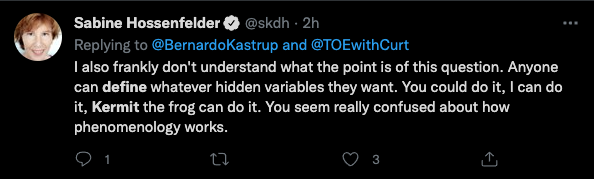
As a matter of fact, Hossenfelder seems to have acknowledged, during the tweet exchange between us upon the publication of her reply, that she adopts a merely linguistic understanding of what a 'definition' entails:
Of course, what Kermit the frog can do is an arbitrary, merely linguistic definition of the hidden variables, such as 'hidden variables are the blueness of the sky,' or something to that effect. But that is not what I could have possibly meant when I confronted her with her lack of theoretical definition; and Hossenfelder, of course, knows it. But just as she did in the debate, she is willing to use dismissiveness, deflection, dissimulated confusion and misleading statements, all for purely rhetorical purposes.
Anticipating a question that is probably coming, I will never say 'no' to a debate against a person whose positions I have taken the initiative to criticize harshly in public. So if Hossenfelder wants to debate again, I am game. That said, I don't think another debate would be any more productive than the first, or take this discussion any further; for I am now convinced, to my own satisfaction, that Hossenfelder does not engage according to what I consider to be the minimum level of intellectual honesty required to render the debate fruitful.
I'm the Executive Director of Essentia Foundation and Founder/CEO at AI systems company Euclyd BV. My work has set off the modern renaissance of metaphysical idealism. I have a Ph.D. in philosophy (ontology, philosophy of mind) and another in computer engineering (reconfigurable computing, artificial intelligence). As a scientist, I have worked for the European Organization for Nuclear Research (CERN) and the Philips Research Laboratories (where the 'Casimir Effect' of Quantum Field Theory was discovered). I've also been creatively active in the high-tech industry for almost 30 years, having founded parallel processor company Silicon Hive (acquired by Intel in 2011) and worked as a technology strategist for the geopolitically significant company ASML. Most recently, I've founded AI company Euclyd BV. Formulated in detail in many academic papers and books, my ideas have been featured on 'Scientific American,' the magazine of 'The Institute of Art and Ideas,' the 'Blog of the American Philosophical Association' and 'Big Think,' among others. My most defining book is 'Analytic Idealism in a Nutshell: A straightforward summary of the 21st-century's only plausible metaphysics.'