YouTubing physicist Sabine Hossenfelder has now replied to my criticism of her debate performance against me, published yesterday on this blog. Her reply can be found here. As you read it, try to keep in mind the context. Namely, in my criticism I focused on the following statement that Hossenfelder made during the debate:
I argued that this was simply not true: in the papers she referred to as substantiation for her statement, hidden variables are not defined. This is important, for this false statement has set the ethos of the entire debate, and made me look like I was fatally uninformed about her output. I had just "looked at the wrong paper," poor silly me:
Her reply now is, one would assume, meant to argue that her statement that she did define the hidden variables somewhere is, in fact, correct. Now go ahead and read her reply with this in mind, before I influence you with my commentary below.
Notice first that the first 14 paragraphs of her reply have absolutely nothing to do with the points in contention. They broaden the scope of the discussion not only beyond physics, but beyond anything of any technical relevance to the discussion. This is particularly peculiar since Hossenfelder had insisted, as a precondition for her participation in the debate, that the scope be limited to her superdeterministic views alone, and not encompass anything beyond, especially philosophy. I had to agree to that. But now she voluntarily broadens the scope way beyond my wildest dreams. One must wonder what motivated her to do so, instead of staying focused on the very specific issues in contention. Be that as it may, right now the roles seem to be inverted, for I am much more interested in staying very sharply focused on the issues in contention.
I leave it to you to interpret the 14 initial paragraphs of her reply and extract conclusions from them. I think what they reveal is clear enough (and interesting, too) to obviate further commentary from me.
Now, notice that in the rest of her reply, instead of trying to argue that, as per the video clip above, she did define the hidden variables, she tries instead to justify why she didn't. As such, her reply is a rather explicit admission that her categorical statement during the debate was indeed false: she did not specify the hidden variables in those earlier papers. I will quote the salient passages of her reply below just for an abundance of clarity; but basically the entire reply, after the weird initial paragraphs, is an admission. I use snapshots below to preclude any chance of misquoting her.


The above is pretty clear: she is justifying why she did not define the hidden variables; after all, it's a "waste of time" to do so and she is very busy. Be that as it may, this unambiguously confirms my criticism: Hossenfelder misrepresented her own work during the debate, in order to save face and try to make me look like someone fatally ignorant of her output. And as an aside, the reason why "there are too many ways [the hidden variables] could be [defined]" is that they are entirely arbitrary figments of the imagination, ungrounded in empirical observation, so anything goes.
Now a very strange passage:

Indeed she said that at a later passage of the debate, but that isn't the point. The point is that she is suggesting here that it was me who incorrectly said that she claimed to have defined the hidden variables; she has always maintained that she never did it! To this, I can only offer the following, once again:
I am not doing this just to gratuitously and repeatedly stick my finger in the wound; I'm not trying to do character assassination. But during the debate Hossenfelder attempted (and probably succeeded, in the eyes of many viewers) to make me look like an ignorant fool by flat-out misrepresenting her own output. I ought to defend myself against that overt suggestion, which I consider to have been rhetorical and dishonest, violating all basic debate ethics. Just consider the vibe in this segment again, and pretend that you don't know what you now know, having read my posts and, above all, her admission:
Now, if at this point you feel like ignoring this whole thing because it's becoming too personal and ugly, and not about content anymore, I urge you to stay the course, because it's integral to understanding what's going on in our culture. The problem is largely about trust and character. The accumulated human knowledge at our disposal today makes it impossible for any one person to know enough about everything of relevance without having to trust some authority figure. Therefore, we must trust someone, and choosing who to trust is critical.
What this ugly engagement shows is that it is entirely possible for someone who sincerely considers themselves honest to arbitrarily dismiss substantive points, deflect and mislead to a level that flirts with lying, just to save face and avoid being pinned down during a debate, thereby protecting their public image at the cost of someone else's. How many of Hossenfelder's YouTube subscribers have the knowledge of particle physics required to objectively and critically evaluate her countless bold claims? How many even want to do so, as opposed to taking her on her word, insofar as it confirms their own views and provides reassurance?
This is the cultural game today. If you want to really understand what's happening, an engagement like this one is quite revealing, even if ugly.
Now a slightly more technical point, for the sake of completeness, if you still have the energy to stay with me on this. The point of her reply where Hossenfelder suggests some possible definition of the hidden variables is this:

Of course, to just say that the hidden variables are "the degrees of freedom of the detector" is just a linguistic definition, and a very loose one at that, not a scientific one. For comparison, imagine a neuroscientist saying: "consciousness is the involuntary wiggling of the left big toe." This, too, is a linguistic definition, but not a scientific one. For scientific definitions entail characterizing the thing defined in a way that is explicit and coherent with the role the thing is supposed to play within a theory. In the case of consciousness, the neuroscientist would have to justify their definition by explicitly and coherently hypothesizing a link between left-big-toe-wiggling and the felt qualities of experience.
For instance, not that long ago the Higgs boson was just an imaginary theoretical entity: it had never been observed (well, actually it had been, but we didn't have enough statistics to claim a discovery). Nonetheless, imaginary as it was at the time, it was still scientifically defined: Peter Higgs had given us a fairly complete, explicit and coherent characterization of the Higgs boson, and its role within the standard model. We knew the energy ranges in which we expected to find it; we knew which particles it likely decayed into and why it did so; importantly, we also knew how it played its role within the standard model: namely, by accounting for inertia (i.e. making sense of why not everything is moving at the speed of light all the time) through its associated Higgs field. Now that was a scientific definition of an imaginary theoretical entity. Hossenfelder provides no such a thing; not even remotely (and no, her 'toy model' obviously doesn't count, because, as the first author of her own paper admits explicitly and as discussed in my previous post, that model is not applicable to... well, reality).
As a matter of fact, Hossenfelder seems to have acknowledged, during the tweet exchange between us upon the publication of her reply, that she adopts a merely linguistic understanding of what a 'definition' entails:
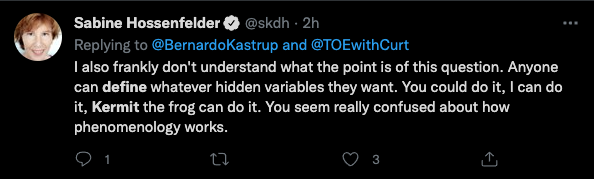
Of course, what Kermit the frog can do is an arbitrary, merely linguistic definition of the hidden variables, such as 'hidden variables are the blueness of the sky,' or something to that effect. But that is not what I could have possibly meant when I confronted her with her lack of theoretical definition; and Hossenfelder, of course, knows it. But just as she did in the debate, she is willing to use dismissiveness, deflection, dissimulated confusion and misleading statements, all for purely rhetorical purposes.
Anticipating a question that is probably coming, I will never say 'no' to a debate against a person whose positions I have taken the initiative to criticize harshly in public. So if Hossenfelder wants to debate again, I am game. That said, I don't think another debate would be any more productive than the first, or take this discussion any further; for I am now convinced, to my own satisfaction, that Hossenfelder does not engage according to what I consider to be the minimum level of intellectual honesty required to render the debate fruitful.