Top-down Individuation: Nonduality and the Fallacies of Panpsychism and Artificial Sentience


Promotional poster of the Science and Non-Duality Gathering 2015.

Here is the abstract of my upcoming presentation at the Science and Non-Duality Gathering 2015, in San Jose, California, coming October:

We live in culture dominated by two contrived metaphysical inferences: that the world exists outside consciousness and that particular arrangements of matter in that world somehow generate consciousness. This distorted view of reality feeds the delusory dreams of artificial consciousness so prevalent in the media today, such as in movies like Ex_Machina.

In contrast to science fiction, however, there is the cold science fact of our complete failure to articulate, even in principle, how particular arrangements of matter could possibly generate consciousness. But instead of forcing our culture to revise its mistaken metaphysics, this failure is leading to a new delusion: panpsychism, or the notion that consciousness is in all matter, as opposed to all matter in consciousness. Under panpsychism, consciousness is fundamentally fragmented, just as matter appears to be. Single atoms allegedly have very simple consciousness, while more complex psyches, such as our own, can be built bottom-up by connecting atoms together.

In this talk, we will see how both panpsychism and our dreams of artificial consciousness arise from a delusory interpretation of the facts of reality, as available to experience. We will see that consciousness isn’t created, but the framework wherein all creation happens. We will see that consciousness isn’t fundamentally fragmented, but fundamentally one. We will see that individual psyches don’t arise from bottom-up integration, but from top-down dissociation of a single consciousness. Finally, we will see how all this follows directly from true non-dualism.
Share:

The elevator pitch of a world in consciousness


A dangerous web of concepts.
Photo by Bernardo Kastrup, hereby released into the public domain.

It strikes me how often discussions about the nature of reality get muddled in misunderstandings arising from concepts. Words like 'mind,' 'consciousness,' 'subjectivity,' and even 'world' can evoke all kinds of unintended meanings, depending on the listener's background, expectations, prejudices and proclivities. 'Isms' like 'idealism' and 'panpsychism' are even worse, since they hopelessly attempt to package, in only a few letters, the meanings of disparate and complex ideas that have taken many books to expound on. As a result of this conceptual pollution, we get caught in a dangerous web of words that make simple, self-evident arguments look tortuous, complex and even implausible.

Ideally, I would love to do away with words and convey meaning directly, through some form of telepathy. But until we figure out a way to do that, I'm afraid we're stuck with words. The best we can then hope to accomplish is to make as few assumptions as possible about the meaning that words will carry to different listeners. This extremely short essay is my effort to summarize my views on the nature of reality in precisely that way. In what follows, what I do not say is just as important as what I do say. So please police yourself to avoid projecting meaning onto what is stated below that actually isn't there. Here we go:

  1. I consider it self-evident that experience exists. The redness of an apple, the sweetness of an orange, the warmth of a hug, the spaciousness of a landscape: they all obviously exist as experiences, illusory or not.
  2. Therefore, I must acknowledge the existence of that which experiences.
  3. I argue that experiences are behaviors of that which experiences, like the dance of a dancer. For the same reason that the dance is nothing but the dancer in action, experiences are nothing but that which experiences in action.
  4. The behavior of that which experiences and the witnessing of such behavior by that which experiences are a single process: experience.
  5. Therefore, there is no reason to infer the existence of objects separate from that which experiences: its behaviors alone account for the entirety of what we call the empirical universe.
  6. I model these behaviors as oscillations, vibrations or excitations of that which experiences, much like a ripple is an oscillatory behavior of water.
  7. Given our linguistic associations, I consider it entirely valid to call that which experiences 'mind' or 'consciousness.'
  8. I also consider it valid to say that that which experiences is a 'subject,' despite the absence of objects. After all, our culture has come to consider experience a phenomenon exclusive of subjects.
  9. I argue that the inner-lives of different living beings are dissociated streams of experience of that which experiences.
  10. Finally, I argue that metabolizing organisms  that is, living bodies – are what these dissociated streams of experience look like from a second-person perspective.

For a book-length elaboration of these ideas, please consider perusing my latest book, Brief Peeks Beyond.

Available online.
Share:

Mind and Brain: A skeptical look


Photo of my presentation at the Alzheimer Symposium, Amsterdam, June 2015.

Below is my presentation at the Alzheimer Symposium 2015 last June in Amsterdam, with corresponding blurb. Enjoy!

Blurb:
Perhaps no other disease has a more fundamental bearing on our sense of identity and the nature of mind than Alzheimer’s. It wreaks havoc with the human psyche and one’s sense of self by corrupting the brain. Precisely for this reason, Alzheimer’s raises one of the oldest questions in history, investing it with a renewed sense of urgency: What exactly is the relationship between mind and brain? Surprisingly, in what is called the ‘hard problem of consciousness,’ no one in science or philosophy today has any idea how brain metabolism can lead to conscious experience or our felt sense of self. Yet, we operate under the assumption that it somehow does, for the correlations between brain function and subjective experience are overwhelming. In fact, Alzheimer’s disease is a particularly compelling instance of such correlations, wherein destruction of brain tissue fundamentally alters our subjective experience of life. But is this assumption the only rational and empirically honest framework for interpreting the relationship between mind and brain? In this talk, we will critically review the array of reasons we assume that the brain generates the mind. We will inquire if these reasons are indeed sound in view of logic and the available data, and what other alternatives there might be to rationally make sense of observations. The presentation will not offer definitive answers, but rather invite the audience to take a broader look at the issue, in the spirit of skepticism. It is hoped that such a broader perspective into the nature of self and its relationship to brain function will lead to new insights, for both caregivers and patients, on how to relate to Alzheimer’s disease.

Share:

The heart of the matter

A few hours ago, I had a lively and productive dialogue with Canadian author and filmmaker Jean-Francois Martel, which is now episode 6 of my Inception Dialogues podcast. See the video below. As my regular readers know, Martel and I exchanged criticisms through our respective blogs in the past couple of months. See, for instance, this article. However, this latest dialogue helped both of us notice more commonalities between our respective positions than we had realized before.


One particular topic, however, deserves further elaboration than what was discussed in the dialogue. Martel considered it the heart of our disagreement: one hour, 2 minutes and 25 seconds into the video, he refers to my four-point argument against materialism, as discussed in my earlier book Why Materialism Is Baloney. The four points consist of increasingly inflationary statements about reality that are entailed by materialism. Here they are:
  1. Your conscious perceptions exist;
  2. The conscious perceptions of other living entities different from your own, also exist;
  3. There are things that exist independently of, and outside, conscious perception;
  4. Things that exist independently of, and outside conscious perception generate conscious perception.
In a nutshell, a materialist must grant all four points. An agnostic realist must grant the first three. An idealist grants only the first two. And finally, a solipsist grants the first point alone. As an idealist, I grant points one and two, but not points three and four. As an agnostic realist, Martel grants points one, two and three. His motivation is the following:
How does statement two not imply statement three? ... Because for there to be other living beings that I can then judge to be conscious or not conscious, I need to believe they exist outside of me.
To believe that they exist outside of you – that is, outside the stream of conscious experiences you call your life – does not require that they exist outside consciousness itself. It only requires that there be other streams of conscious experience different from your own, which is precisely what is stated in point two. By denying point three, I don't deny the inner lives of other people, since their inner lives are in consciousness. I don't deny that you have an inner life – a personal stream of experiences – different from mine and ordinarily inaccessible to me. I don't deny that you have experiences that I don't necessarily have. But your inner life is in consciousness and so is mine. By acknowledging that you have your own inner life I am not forced to acknowledge that this inner life is hosted, generated, modulated, or otherwise couched in anything outside consciousness. I am simply acknowledging a broader variety of experiences than those I ordinarily have access to as an individual. And the inner lives of other living beings appear in my inner life as the subjective images I call other bodies. My subjective inner life appears in your inner life as your subjective perception of my body. Only subjective experience is required.

This is a simple but often misunderstood point. The idealist denies that anything exists outside consciousness, but not outside his own personal stream of mentation. Indeed, the idealist acknowledges that countless other experiences do exist, which happen to not be included in his own inner life. None of this implies that there must exist anything outside experience itself, since I am only talking about different streams of experience. I can grant validity to statements one and two above without any need to grant it to statements three or four.

Addendum of 19 August 2015:

I'd like to summarize some key points that I've had to make in the comments section below:
  1. If one says that the qualities of experience – or qualia in philosophical jargon – like the redness of red or the taste of an orange exist in the world, as opposed to inside our heads, then the world necessarily entails at least one non-personal/trans-personal experiencer. There is no escape from this, since experience by definition entails an experiencer. Redness cannot exist without being experienced as such, since redness is an experience. The only valid point of debate is whether the experiencer is human (or at least human-like) or non-human, embodied or disembodied. I argue that it is disembodied – bodies existing as experiences within the experiencer – and not even human-like.
  2. One cannot explain how different people experience the same world unless one infers something transpersonal, which binds together different streams of personal experience information-wise. Under materialism, a universe of matter outside mind is such an inference. The most parsimonious inference, however, is to simply extend the one thing we know for sure to exist – i.e. mind – beyond its face-value personal boundaries. This is analogous to inferring that the Earth extends beyond the horizon in order to explain the cycle of day and night, instead of postulating a flying spaghetti monster who pulls the sun out of the sky. It is impossible to offer a coherent ontology that isn't solipsist and doesn't infer something beyond ordinary personal experience.
  3. My formulation of idealism differs from Berkeley's subjective idealism in at least two points: (a) I argue for a single subject, explaining the apparent multiplicity of subjects as a top-down dissociative process. Berkeley never addressed this issue directly, implicitly assuming many subjects; and (b) I argue that the cognition of the non-dissociated aspect of mind-at-large ('God' in Berkeley's formulation) is not human-like, so it experiences the world in a manner incommensurable with human perception (details in this essay). In Berkeley's formulation, God perceives the world just as we do.
  4. If one's goal is to offer a viable alternative to materialism as the ontology that grounds our cultural narrative, unarticulated, disconnected intuitions and ambiguities won't do. One needs a coherent, unambiguous and explicit system that (a) explains everything materialism does; (b) preferably explains at least some of what materialism does not explain but which has been empirically verified; and (c) does all this preferably with less ontological categories than materialism. I argue that my formulation of idealism does all three.
Share:

What really happens after death?


Why Materialism Is Baloney

This is the final week of the 99-cent promotion valid for my four earlier titles this July on Amazon Kindle stores worldwide. From the 1st of August onwards, the prices will return to their regular level. So I'd like to close my series of four essays celebrating relevant passages of those titles by quoting the most recent of them, which is also my most popular book to date: Why Materialism Is Baloney. Although it hasn't (yet ;) become a full best-seller, Why Materialism Is Baloney continues to be quietly read by highly influential people in many different fields. Its readership, albeit not voluminous, is a high-quality and high-impact one. The book's true impact on our culture is most-likely yet to be seen.

One question that often comes up is whether the views expressed in the book endorse some form of afterlife or not. For instance, the question has been raised in a recent thread in my Discussion Forum. The book itself has a very explicit answer, starting on page 182, which I reproduce below. If this peaks your interest, you can get the full book, in electronic version, for only 99 cents at your Amazon Kindle store, but only for the next few days. All the concepts and ideas referred to in the extract below are fully elaborated upon in the book.
What really happens after death? The simple answer is: nobody alive knows. But we can make educated inferences from the little we know about life. Indeed, the metaphysics discussed in this book can be tentatively extrapolated towards the after-death state.

It is reasonable to assume that the mental process we call physical death ‘makes the unconscious more conscious,’ because it eliminates a source of obfuscation; namely, the egoic loop. After all, physical death is the partial image of the process of unraveling of the egoic loop. As such, it is reasonable to expect that it causes us to remember all that we already know but cannot recall. From the ego’s perspective, this may seem like receiving all kinds of new answers. But it won’t fundamentally add any original insight to mind. The sense of novelty here is merely the illusion of an ego going through dissolution. Once the ego is gone and all is remembered, the sense of novelty will disappear. One way to think of this is what happens when we suddenly awaken from an intense nightly dream: for a few seconds, we are astonished to remember who we really are and what is really going on (‘Oh, it is a dream! My real life is something else!’). While still half in the dream, we register this remembrance as novel knowledge about ourselves and about what is really going on. But the sense of novelty quickly wanes once we settle back into ordinary conscious states. After all, we simply continue to know what we already knew anyway, but had just forgotten while in the dream. The only true novelty was the experiences of the dream, not what was remembered upon awakening. As such, maybe life and death are entirely analogous to dreaming and waking up, respectively.

The question, of course, is whether self-reflective awareness disappears completely upon physical death. This depends on the topographical and topological details of the human psychic structure, which are not known. If the ego is the only loop in the human psychic structure, then physical death indeed eliminates all self-reflectiveness. But it is conceivable that the psychic structure entails an underlying, partial, not-so-tightly-closed loop underneath the egoic loop. I say this because many Near-Death Experiences seem to suggest that a degree of self-reflectiveness and personal identity survive death. In this case, the ego would be a tight loop perched on top of another partial loop. Assuming that physical death entails the dissolution of only the egoic loop on top, then our awareness would ‘fall back’ onto the underlying partial loop, preserving a degree of self-reflectiveness. The result would be more access to the ‘unconscious’ – due to less obfuscation – but we would still maintain a sense of separate identity. This, of course, is highly speculative.

Even if the ego is the only loop in our psychic structure, there is still another interesting avenue of speculation regarding the preservation of a form of identity in the after-death state. Carl Jung, towards the end of his life, compared the physical body to the visible part of a plant as it grows from the ground in the spring. He thought of the core of the individual as the root (rhizome), which remains invisible underground. Jung’s analogy can be mapped very straightforwardly onto the membrane metaphor: the root is the underlying protrusion that corresponds to the ‘personal unconscious.’ This protrusion, we can speculate, remains largely invisible in ordinary consensus reality because its vibratory ‘footprint’ on the broader membrane is largely filtered out by the ego. The physical body we see may correspond to just a small part of the protrusion, the majority of it remaining invisible. The ego is in the visible part of the plant, which rises in spring and dies in winter. Its partial image in ordinary consensus reality is closed-cycle neural processes in the brain.

Physical death, as such, doesn’t necessarily entail the complete dissolution of the underlying protrusion, but perhaps only some peripheral parts of it, along with the egoic loop. Throughout life, egoic experiences could leak – through resonance – into the ‘personal unconscious’ and accumulate there. This way, our personal history – a key element of our identity as individuals – could largely survive death as well. If this is so, then physical death may bring us back to the world of the ‘personal unconscious’: the world of our memories and dreams. But it may eliminate self-reflective awareness, so we become immersed in the dream without being able to think critically about what is going on; without being able to ask questions like “What is happening? How did I end up here?” We may just re-live our memories and traverse our own dreamscape in a way that transcends time, space, and even logic.

Amid all these speculations, I think only one thing can be stated with very high confidence: physical death does not entail the end of consciousness, for consciousness is the fabric of all existence. In addition, it is reasonable to expect that physical death reduces self-reflectiveness and, thereby, increases our access to the contents of the ‘unconscious’ due to less obfuscation. This last point is another clue to the usefulness of ordinary life: it provides us with a heightened ability to self-reflect about existence and our condition within it.
Share:

The meaning and purpose of life


Rationalist Spirituality

During the entire month of July 2015, my first four books, including Why Materialism Is Baloney, will be available on Amazon Kindle Stores for only 99 cents. You can purchase them all for under $4. This is an effort to make my work more accessible and widespread. To celebrate this, each week in July I will be publishing selected passages from each of the books.

This time, I'll quote a passage from my 2011 book Rationalist Spirituality. This is probably my least rigorous but most accessible book. It discusses very openly the fundamental questions of life, particularly the meaning and purpose of our existence. It also uses a dualist metaphor throughout, implicitly playing with the allegorical image of a soul separate from the body, which can also be read literally if that's your inclination. The passage below comes from Chapter 2 and pretty much sets the tone for what you can expect to find in the rest of this short and pragmatic book.
What happens but once [...] might as well not have happened at all. If we have only one life to live, we might as well not have lived at all. So does world-renowned author Milan Kundera capture the apparent futility of existence and its ephemeral character. If, as indicated by the second law of thermodynamics, all dynamic and organized structures in the universe, amongst which galaxies, stars, and living creatures like you and me, will eventually expire without a trace, existence appears devoid of meaning. From the point of view of orthodox materialistic science, all choices we make and experiences we live throughout our lives will, in time, be of no consequence. As such, our lives are “light” in their insignificance. Such “unbearable lightness of being”, captured so powerfully in Kundera’s work, is an agonizing and profoundly counter-intuitive perspective for many of us.

As rich and satisfying as our lives may sometimes be, most of us are marked by past or present experiences of profound pain and suffering. Loss, disappointment, frustration, anxiety, regret are or have been familiar concepts to most of us. Is there anything we suffer for? And even when everything seems to go well in our lives, we sometimes cannot help but wonder whether there is any meaning in that either. What can be the meaning of our success, our material wealth, of our fleeting moments of happiness, and even of our most profound rejoicing when, given enough time, not a trace or even a memory of our existence will be left behind? From a rational perspective, can there be anything that survives our participation in the universe, adding something to its very essence in a way that transcends time? Without it, there can be no true meaning to the dance of existence.

There are no obvious answers to this question. Yes, our children survive us. The work we carry out during our lives often survives us too, be it through material entities like the buildings of an architect, or more abstract entities like the ideas of a philosopher. But notice, the common thread behind all these tentative answers is the same: whatever outcome of our lives survives us only has meaning through the lives of other people like ourselves. The achievement of meaning is merely postponed in a self-similar way. Your children are people like you. The house built by the architect is only meaningful through the people who will live in it. The ideas and concepts left behind by the philosopher are only meaningful through the people who will read his books. But what, then, is the meaning of the lives of those people? If their lives are meaningless, so has the life of the philosopher been, for the meaning of his life seems to be conditional to that of theirs. This is an endless recursion. If the meaning of your life is the lives of your children, and the meaning of their lives are the lives of their children, and so on, where is the final meaning of it all that confers ultimate purpose to the lives of all previous generations of men, and of men’s ancestors, all the way back to the beginning of time? In mathematics, a recursion cannot complete until a base-case, or termination condition, is reached. Recursions without a base-case continue on forever and are pointless, just like a computer program that does nothing but call itself repeatedly, never producing a result.

It could be that meaning is only realized at the base-case of one such a recursive process. In this case, the meaning of our lives would operate solely through the contributions we make to the lives of the people who survive our own existence, up until a point where the existence of a generation of living beings, perhaps in an unimaginably distant future, will serve an ultimate purpose in itself. Alternatively, or complementarily, it could be that our lives, ephemeral as they may be, somehow have meaning in and by themselves, grounded on the present of our existence.

In the coming chapters, we will explore both alternatives. If, at the end of this exploration, we find no sound base-case for a recursive process of meaning, nor any anchor to ground meaning to the present of our existence, we may be left with the possibility that meaning is either merely an illusion or an unknowable truth. If instead, as I hope to show, there are reasonable ideas and lines of reasoning to substantiate the notion that there is indeed meaning to existence, and that such meaning can be at least intuited, then perhaps the lightness of our being is not at all unbearable. Perhaps the existence of the universe, and of our lives within it, is rich in meaning, significance, and purpose. Perhaps it is precisely the perception of futility and inconsequence that has all along been an illusion of our minds. In this latter case, we will also need to suggest logical and rational mechanisms for the emergence of such an illusion in a universe that is, as postulated, rich in meaning. This is the journey of this book.

As a final note in this chapter, it should be clear that, when I talk of meaning, I refer to an ultimate purpose for the very existence of the universe, defined as the collection of all existing aspects of nature, known and unknown. I do not mean to imply an anthropomorphic purpose to particular, local processes taking place within the universe, such as, for instance, evolution by natural selection. This way, the ideas in this book are agnostic of whether the evolution of the species has an intelligent causal agency or is driven by unintelligent, purely algorithmic processes. Even if we assume the latter viewpoint, there is still a valid question regarding the ultimate existential purpose of the underlying vehicles of the evolutionary process. In other words, even if evolution is the result of mechanical, algorithmic processes operating on a bio-molecular medium, why does that medium, and the natural laws operating on it, exist in the first place?
Share:

Talking each other into consensus reality


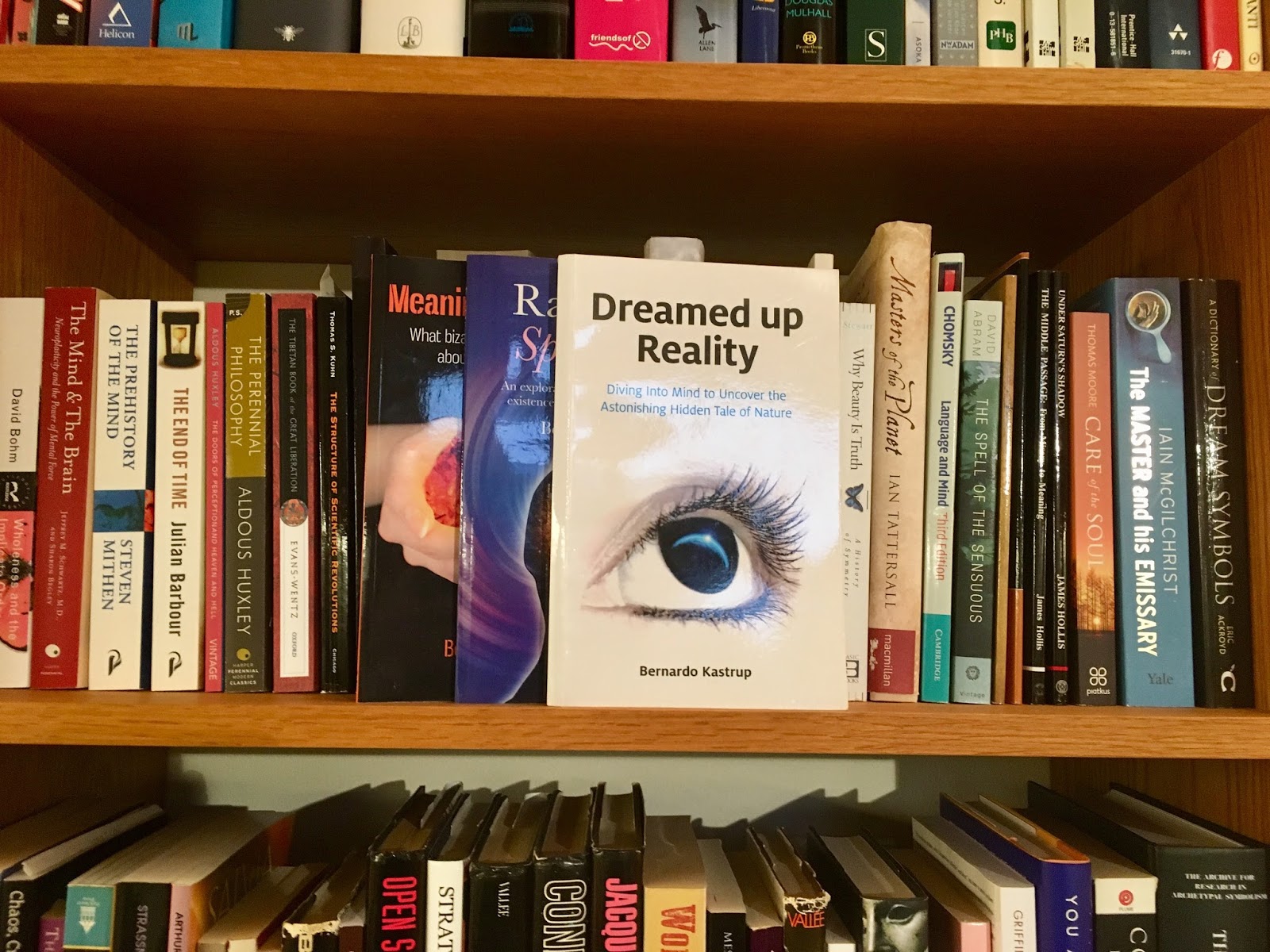
Dreamed up Reality

During the entire month of July 2015, my first four books, including Why Materialism Is Baloney, will be available on Amazon Kindle Stores for only 99 cents. You can purchase them all for under $4. This is an effort to make my work more accessible and widespread. To celebrate this, each week in July I will be publishing selected passages from each of the books.

This time, I discuss my 2011 book Dreamed up Reality. The relevance of this book has grown since last year, when an article published in the renowned science journal Nature argued that reality is mental, its shared aspects emerging out of communication-enabled consensus between observers. In other words, the article suggests that there is no objective world 'out there,' but just inner experiences that we talk each other into agreeing about. As it turns out, this is precisely one of the key lines of discussion in Dreamed up Reality. In the book, I even use computer simulations to explore this idea at the level of first principles, with surprising results.

As my readers know, from my book Meaning in Absurdity onwards I've emphasized a complementary mechanism: that a form of transpersonal consciousness is a reality-synchronizing factor beyond our personal psyches. It still consists purely in subjective mentation, but outside personhood. Such a deeper synchronization mechanism wouldn't require linguistic communication between different people: it would be built right into the fabric of reality as the global, overarching patterns and regularities of nature itself.

I think both mechanisms ultimately play a role, at different levels. But because my three latest books focus on the archetypal unfolding of transpersonal consciousness, which we call the "laws of classical physics," the "we-talk-each-other-into-consensus" possibility argued in Dreamed up Reality has become largely forgotten. May this essay help rectify this situation.

In addition, my latest books are rather sober, rigorous philosophical discourses. They are grounded in reason, logic and empirical science. This way, the more intimate and experiential aspects of my work, present so strongly in Dreamed up Realityhave also become practically forgotten. I, too, have had deep, direct, transcendent experiences, which have significantly contributed to my present philosophical views. Some of these experiences, as well as the background of how I ended up having them, are described at length in Dreamed up Reality. To impress this point upon you, I quote one of them below:
The initial stages of the experience pretty much followed the previously established pattern. Upon crossing the threshold into a non-ordinary state of consciousness, I found myself once more in my own “private” inner theater, with the familiar and evocative mandala patterns and Kandinsky scintillae waiting for me. I stayed centered, carefully avoiding a drift into negative emotions that could set an undesirable tone for the rest of the experience. I visualized the feeling of learning something about the underlying nature of reality. This visualization was strong, for I very sincerely wished for greater understanding. Behind my visualization, perhaps hidden in my subconscious mind, there was a hint of disappointment that I had not yet had an unambiguous insight about reality, like many others had reported as a result of their subjective exploration practices.

From the familiar inner theater, I drifted further into that state of egolessness and non-life that I described earlier. This time, however, I recognized it as it was happening. I welcomed it and continued to actively try and keep my mind centered and disciplined as the experiment unfolded. Thankfully, I did not think about how difficult my previous return from egolessness had been.

My efforts to stay centered and lucid paid off. Shortly after reaching the state of egolessness, I broke through into new and uncharted territory. New, previously unseen images started flashing in my mind, accompanied but strange thoughts. I cannot recall what they were, but I remember wondering about what was going on. Some of the images seemed vaguely to resemble some weird form of visual art, akin to cubism. Whatever it was, it was very peculiar, as if I were tapping into a mind not my own; as if I were witnessing things, events, images, thoughts, and emotions that did not belong to me, or to any normal human being for that matter. It was not scary though: I was relaxed, open-minded and, frankly, very curious.

More than in previous experiments, I find it extraordinarily difficult this time to recall the details of the experience. Like a regular dream that one forgets seconds after waking up, this time the experience began fading fast, even before I was back to more ordinary states of consciousness. Still, I remember that, at some point in the experiment, I was saying repeatedly in thought: “I am trying, but I cannot understand it... I am trying...” Something was being displayed in the screen of my mind; something extraordinarily profound and complex, but I could not make sense of it. It was very, very hard to grasp, whatever it was.

The gestalt of the experience was that of a “better informed” alter ego of mine trying to convey something to his space-time-bound doppelganger. I had a hard time making sense of “his” message. Yet, very slowly, the entire situation started becoming clearer. At some point, I felt as though my supposed alter ego were metaphorically opening the dome of inner theater above my head – like the moving dome of an astronomical observatory – revealing a profound and unprecedented truth operating busily and inconspicuously just behind what had previously been the boundary of my perceptual universe.

What I then “saw” was indescribable. How inadequate words are. This... “thing” that was revealed... froze me to the spot. It was a pattern. Whatever doubt I might have harbored about whether these experiences truly entailed knowledge input from outside my brain evaporated: there was absolutely no way this thing, this unfathomable miracle of a pattern, could have come out of my primate head.

Suddenly it was completely clear. I could understand it! It was an unbelievably complex, yet self-explanatory evolution of concentric patterns growing out of concentric patterns; like self-generating, hyper-dimensional mandalas recursively blossoming, like flowers, out of the centers of previous hyper-dimensional mandalas, ad infinitum, but with a single point of origin from where it all emanated. This point of origin, this Source of it all, however, remained elusive: hidden behind the layers of wonders growing outwards from it. Somehow, the way new patterns unfolded and evolved was already entirely encoded in, and determined by, the very shapes, angles, and proportions entailed by previous patterns, so that no new primary information was ever added to the thing as it evolved. The entire story was already fully contained in it from the very beginning, and it was simply unpacking and manifesting itself in all its indescribable glory. It was a thing of startling power and beauty, yet put together with a level of sophistication and perfection that goes way beyond anything I could compare it to.

I was flabbergasted with how unambiguous this experience was. No fluffy and debatable impressions here; this thing was there. I could hardly believe it. Despite its sheer complexity, and unlike diagrams in a textbook – which require captions for their meaning to be made clear – this thing was entirely self-evident in its perfect harmony. Simply by “looking” at it I understood not only it, but its far-reaching implications as well. This was the answer to the question that haunted me my entire life: this thing, this miraculous, hyper-dimensional, evolving pattern, was the definitive explanation to the underlying structure of reality. There was no doubt. This settled the question entirely. One simply needed to “look” at it with the mind’s eye to know that this is how reality came to being; this is how nature was formed; this is what nature is; this is what is behind everything. There, in that pattern, in its wondrous shapes and features, in the angles, lengths, proportions, and relationships among its components, and in the way it evolved recursively as if re-birthing itself continuously, was the answer to everything. The pattern was the answer. At this point of the experience, there was no other reality to me but this jaw-dropping thing that was unfolding and revealing itself; physical body and life in linear time completely forgotten.

From the moment the metaphorical dome began to open, I felt thoughts in my mind that I did not recognize as my own. These were clearly and very gently articulated statements that popped seemingly out of nowhere: “You wanted to know... so here is how it is, you see? This is how it is...” These words came invested with a sense of calm and benevolence. “This is how it all is, you see?” spoke my supposed alter ego, borrowing my own voice.

...

My reasoning machinery was operating in overdrive. I could not stop “looking” at that miracle of a thing, trying to somehow articulate its implications in language. But it was impossible. I thought to myself: “this is not meant for human consumption.” The mere attempt at articulating it was exhaustive. I noticed I was – and I cannot avoid the expression – frying my brain to a crisp. It was overwhelming and painful in a non-physical way. I thought I would go insane, and it dawned on me that this is what insanity may feel like. Yet, I felt as though my mysterious alter ego were aware of how dangerous and distressing this kind of knowledge could be, and were somehow controlling the “dose,” if you will. That was a reassuring thought, whether factual or not.

I concluded with certainty then that one must be literally insane in order to comprehend this thing. The magnitude of it, its hyper-dimensional character, and its implications, cannot be apprehended unless one completely abandons all pre-existing mental models, semantic frameworks, assumptions, and paradigms of thought one holds. Losing all this mental infrastructure comes very close to the definition of mental pathology. In fact, I understood then why ego dissolution appeared to be a necessary pre-requisite for exposure to that miraculous pattern: the preconceptions, expectations, and closed thought paradigms of the ego would prevent one from even seeing the pattern for what it is, let alone understanding it. The ego would dress it up and squeeze it into lower-dimensional models that would limit the perception of its true nature. Perhaps the mandalas I saw in inner theater were but such lower-dimensional, fragmentary projections or resonances of that miraculous pattern. Perhaps the mandala drawings used by mystics the world over are even lower-dimensional projections of it. There seems to be a hierarchical progression of states of consciousness leading to the state that made such understanding possible: from consensus reality, to the inner theater of mind, to ego dissolution, to this.

...

Now, as I write these words, I face the formidable challenge to try and articulate the unfathomable. Whatever I do, I am certain that more than 99% of the meaning, nuances, and richness of what I perceived have been lost upon the precarious imprinting of the impressions onto my brain. But I will do my best. The following paragraphs represent my feeble attempt at articulating some of what was instantaneously obvious to me merely upon “glancing” at the indescribable pattern I referred to earlier. The words capture but a very modest part of the pattern’s self-evident and far-reaching implications. I do not know how an abstract pattern could entail or imply so much concrete information. I will simply record this information here as I recall it, with suspended judgment and critique about its validity. Later we will have occasion for rational analysis.
Share: